BREAKING NEWS
Showing posts with label Endemic. Show all posts

Friday, April 11, 2014

Serendib Scops Owl

The Serendib scops owl (Otus thilohoffmanni) is the most recently discovered bird of Sri Lanka. It was originally located by its unfamiliar poo-ooo call in the Kitulgala rainforest by prominent Sri Lankan ornithologist Deepal Warakagoda. Six years later, it was finally seen by him on 23 January 2001 in Sinharaja, and formally described as a species new to science in 2004.Apart from Sinharaja and Kitulgala, it has also been found at Runakanda Reserve in Morapitiya and Eratna Gilimale. Known as Panduwan Bassa in Sinhala.

It is the first new bird to be discovered in Sri Lanka since 1868, when the Sri Lanka whistling thrush—then Ceylon whistling thrush—(Myophonus blighi) was discovered. It is also the 24th (according to some authorities the 27th) endemic bird species for Sri Lanka.

The habitat of the Serendib scops owl is in the southern rain forests of Sri Lanka. There is an altitudinal range from 30 to 50 metres. This owl has no competition from other nocturnal birds, the territories are completely different. This species has a very small population, at the end of January 2006 only 80 of them were known to exist.The places that it is expected to be found are in five protected areas, like the Forest Reserve or the Proposed Reserve by Sri Lanka. They seem to be declining because of the loss of habitat and the degradation. The first two hours of darkness is when the owl hunts for its food.

This rare species inhabits the rainforests in the southwestern part of Sri Lanka. Like most owls, it is strictly nocturnal and hunts insects (e.g. beetles and moths) close to the ground. It begins calling at dusk, its frequency rising again some two hours before dawn.

Unlike the other two species of scops owl in Sri Lanka, collared scops owl (Otus bakkamoena) and oriental scops owl (Otus sunia), it does not have ear tufts and its facial disc is only weakly defined. The general colour of this 16.5 cm long, short-tailed owl is reddish brown with paler underparts, spotted all over with fine black markings. The irides are tawny yellow (more orangish in male) and the feet are a pale fleshy colour. Tarsi are feathered for less than half their length. The claws and bill are a pale ivory colour

Wednesday, April 2, 2014

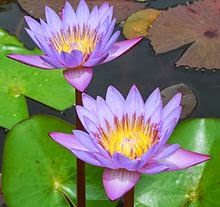
Blue Water Lily

It is the national flower of Sri Lanka.Nymphaea nouchali is a day-blooming nonviviparous plant with submerged roots and stems. Part of the leaves are submerged, while others rise slightly above the surface. The leaves are round and green on top; they usually have a darker underside. The floating leaves have undulating edges that give them a crenellate appearance. Their size is about 20–23 cm and their spread is 0.9 to 1.8 m

This water lily has a beautiful flower which is usually violet blue in color with reddish edges. Some varieties have white, purple, mauve or fuchsia-colored flowers. The flower has 4-5 sepals and 13-15 petals that have an angular appearance making the flower look star-shaped from above. The cup-like calyx has a diameter of 11–14 cm
In Sri Lanka this plant usually grows in buffalo ponds and natural wetlands. Its beautiful aquatic flower has been mentioned in Sanskrit, Pali and Sinhala literary works since ancient times under the names kuvalaya, indhīwara, niluppala, nilothpala and nilupul as a symbol of virtue, discipline and purity. Buddhist lore in Sri Lanka claims that this flower was one of the 108 auspicious signs found on Prince Siddhartha's footprint.It is said that when Buddha died, lotus flowers blossomed everywhere he had walked in his lifetime


Tuesday, April 1, 2014

Sri Lanka Jungle Fow

The Sri Lankan Jungle fowl (Gallus lafayetii), also known during the colonial era as the Ceylon Jungle fowl, is a member of the pheasant family which is endemic to Sri Lanka, where it is the national bird As with other jungle fowl, the Sri Lankan Jungle fowl is strongly sexually dimorphic: the male is much larger than the female, with more vivid plumage and a highly exaggerated wattle and comb.

The male Sri Lankan Jungle fowl ranges from 66–73 cm (26–29 in) in length and 790–1,140 g (1.7–2.5 lb) in weight, essentially resembling a large, muscular rooster. The male has orange-red body plumage, and dark purple to black wings and tail. The feathers of the main descending from head to base of spine are golden, and the face has bare red skin and wattles. The comb is red with a yellow centre. The female is much smaller, at only 35 cm (14 in) in length and 510–645 g (1.1–1.42 lb) in weight, with dull brown plumage with white patterning on the lower belly and breast, ideal camouflage for a nesting bird. Sri Lanka Jungle fowl is a terrestrial species. It spends most of its time foraging for food by scratching the ground for various seeds, fallen fruit and insects.

It is a ground nesting bird, and lays 2-4 eggs in a nest. Similar to many members of the pheasant family, the colourful male plays no part in the incubation of the eggs or rearing. These duties are performed by the drab and well-camouflaged female. It is common in forest and scrub habitats, and is commonly spotted at sites such as Kithulgala, Yala and Sinharaja


Sri Lanka Spurfowl (Haban Kukula)

The Sri Lanka Spurfowl (Haban Kukula) is a member of the pheasant family which is endemic to the dense rainforests of Sri Lanka.

It is a very secretive bird, and despite its size is difficult to see as it slips through dense undergrowth. Often the only indication of its presence is its distinctive ringing call, consisting of series of three-syllabled whistles. Kitulgala and Sinharaja are sites where there is a chance of seeing this bird.

This spurfowl is one of three species of bird in the genus Galloperdix. It is a ground nesting bird, which lays 2-5 eggs in a scrape.

Sri Lanka Spurfowl is ~ 37 cm long bird. Both sexes have brown upperparts, wings and tail. The males exhibit vivid crimson red legs and bare facial skin.

The adult male exhibits striking black and white dorsal plumage that extends to its head. There is also extensive white ocellation on the sepia wings and upperback. The legs of both sexes have multiple metatarsal spurs, which give rise to the specific name. The female has chestnut underparts and a plain brown back and wings. She is more prominently crested than the male.

Like most of the Peacock-Pheasants, Sri Lanka Spurfowl is a seasonally terrestrial species. It scratches vigorously amongst the leaf litter of the forest floor for invertebrates, especially mollusks and insects. It will also take various seeds, fallen fruit and spiders.


Copyright © 2014 Explore Sri Lanka